
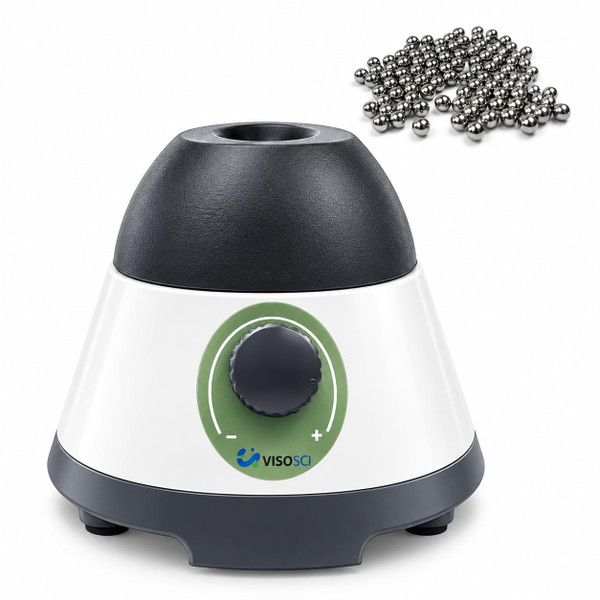


Product Overview
Brand: VISOSCI
Features:
- TOUCH-START OPERATION: The speed dial controls mixing speed; the motor starts only when a container is pressed onto the silicone cup. Place the container over the center of the cup and press straight down with moderate pressure to start. ? Once running, maintain light, steady contact and allow the mixer to vibrate freely. Lift the container away to stop.
- ADJUSTABLE 0–3500 RPM SPEED: Set the desired speed before pressing the container to start. Choose a lower setting for gentler mixing or increase the speed toward 3500 RPM for a more vigorous vortex. Higher speed produces stronger vortex action, while lower speeds provide more controlled mixing.
- STAINLESS STEEL MIXING BALLS FOR PAINT & PIGMENT MIXING: Includes 50 reusable stainless steel mixing balls that move with the vibration to help break up settling, promote dispersion, and improve mixing of paints, pigments, nail polish, inks, and other compatible liquids. Particularly useful for materials that tend to settle or separate during storage.
- EFFECTIVE VORTEX MIXING: Vortex mixing works best when the liquid has room to move inside the container. For low-viscosity liquids, filling to about one-third of the container capacity is recommended for stronger circulation and vortex formation. Higher fill levels may still mix, but less empty space can limit liquid movement and reduce vortex action.
- FOR A RANGE OF MIXING APPLICATIONS: Suitable for laboratory samples, paints, pigments, inks, nail polish, test tubes, centrifuge tubes, and other compatible liquids. Mixing performance depends on material viscosity, container shape, fill level, selected speed, and the use of mixing balls. Extremely thick materials that cannot be readily stirred by hand may require thinning or other preparation before mixing.
Details: ● Adjustable-Speed Vortex Mixer for Paint, Pigment & Laboratory Mixing: The VISOSCI Vortex Mixer combines adjustable 0–3500 RPM speed control, touch-start operation, and 50 stainless steel mixing balls for convenient mixing and dispersion of laboratory samples, paints, pigments, inks, nail polish, and other compatible liquids. ● Touch-Start Operation — Press to Start, Lift to Stop: The speed dial controls the mixing speed; it is not a power switch. After the mixer is connected to power, the motor does not run until a container is pressed onto the silicone mixing cup. Place the container over the center of the cup and press straight down with moderate pressure. ? Once the mixer starts, maintain light, steady contact and allow the mixer to vibrate freely. Avoid excessive downward force, which can restrict vibration and slow or stop the motor. Lift the container away to stop mixing. ? There is no need to unplug the mixer between normal uses. When the mixer will not be used for an extended period, unplug the power supply for storage. ● Adjustable 0–3500 RPM Speed: Set the desired speed before pressing the container to start. Lower speeds provide more controlled mixing, while higher settings produce a more vigorous vortex. Increase the speed toward 3500 RPM when stronger vortex action is desired. ● 50 Stainless Steel Mixing Balls for Enhanced Mixing: The included 50 reusable stainless steel mixing balls move with the vibration of the mixer and travel through the liquid during operation. For paints, pigments, nail polish, inks, and similar materials that may settle or separate during storage, the moving balls can help break up settled material and promote dispersion throughout the liquid. The mixing balls are an additional mixing aid, not a replacement for mechanical stirring or homogenization. ● Leave Enough Room for Liquid Movement: Vortex mixing relies on movement and circulation within the container. For low-viscosity liquids, leaving sufficient empty space allows the liquid to move more freely and form a stronger vortex. For best vortex performance, filling the container to about one-third of its total capacity is recommended. A higher fill level may still mix, but reduced empty space can limit liquid movement and weaken vortex action. This recommendation is especially relevant when using tubes or containers that can be filled before mixing. For pre-filled paint or other product containers, use the available space together with an appropriate speed setting. ● Understand the Mixing Limits: Mixing performance depends on the physical properties of the material. Lower-viscosity liquids generally move more freely and can form a stronger vortex when sufficient space is available. For paints, nail polish, pigments, inks, and other materials that may settle or separate, the included stainless steel mixing balls can provide additional mechanical movement within the liquid and help improve dispersion. ?? However, extremely thick materials that are difficult to move or stir by hand may exceed the practical capability of vortex mixing. In such cases, the material may need to be thinned or otherwise prepared according to its intended use before mixing. This mixer uses vibration and vortex action rather than a mechanical stirring shaft or homogenizing blade.


